All Features. One Self-Hosted Platform.
MobilityManager covers the complete lifecycle of fleet operations — from the vehicle file and self-service bookings to licence control, traffic fines, maintenance, fuel, warehouse and total cost of ownership. Every module ships in the same installation and shares the same data.
Built for the work a fleet team actually does
Six areas that decide whether a fleet runs on software or on spreadsheets. The other 23 modules are listed below.
Vehicle file
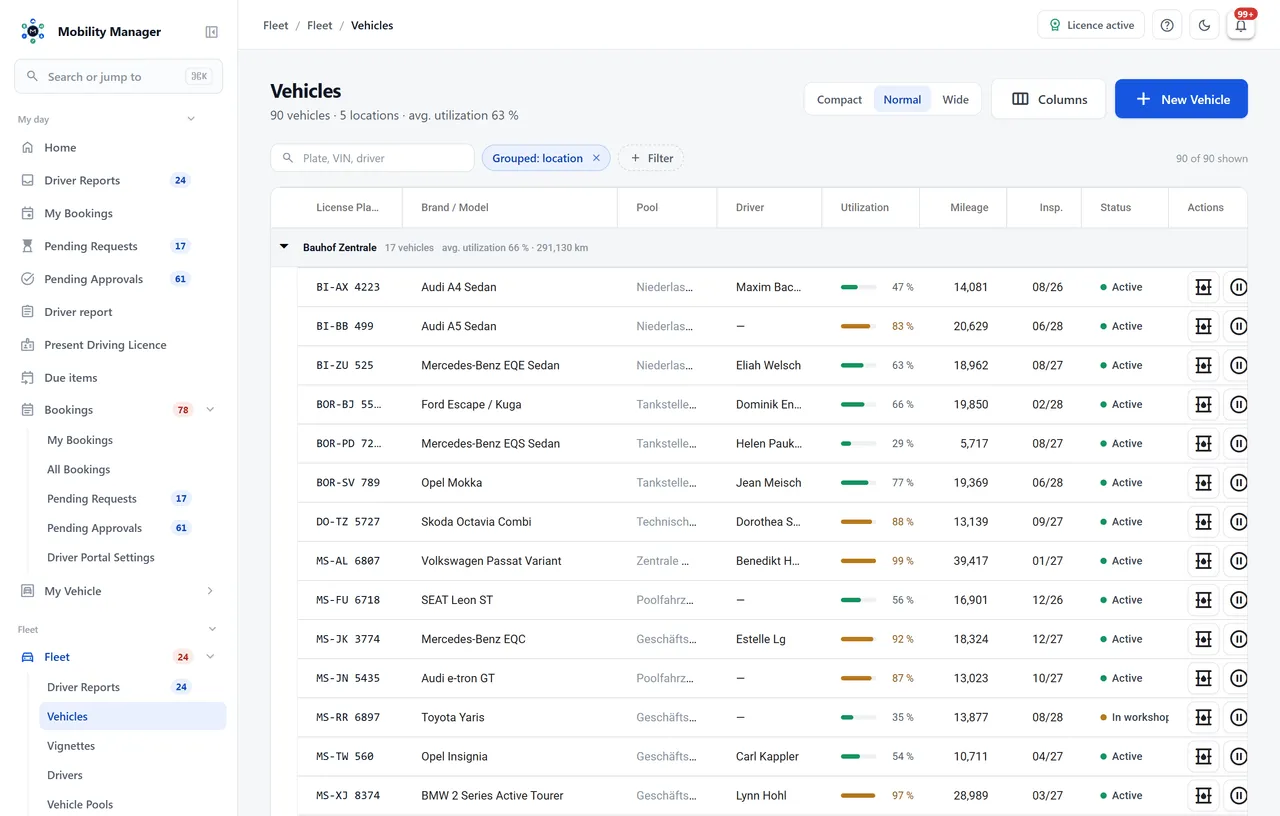
The complete vehicle file — instead of 18 folders on a shelf
The vehicle file is the hub of MobilityManager: every other module writes back into it. A refuelling, a service, a traffic fine or a damage case shows up in the right tab automatically — nothing is maintained twice. The vehicle lifecycle is modelled explicitly: planned, in service and retired are distinct states with distinct rules.
Bookings & dispatch board
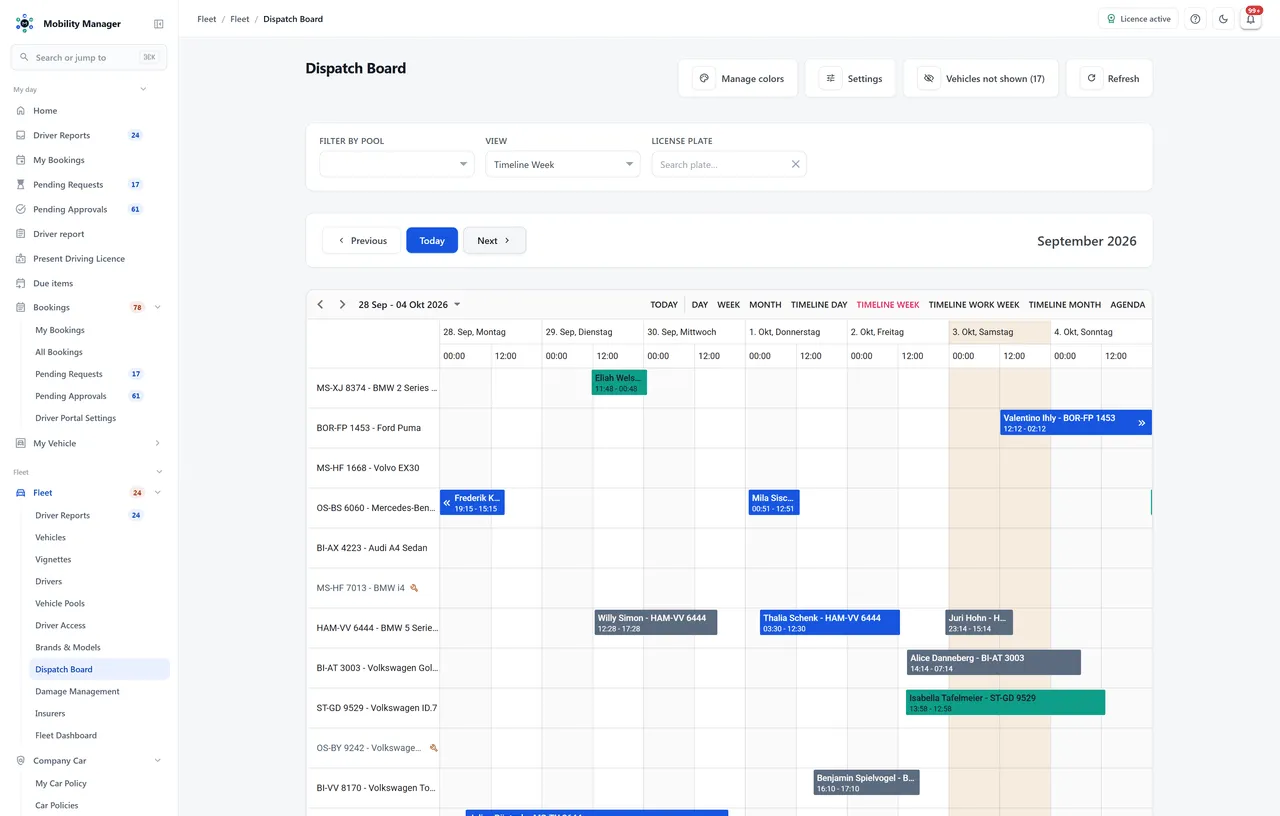
Employees book themselves. Dispatchers plan on a board.
The booking module replaces key-cabinet lists, shared Outlook calendars and shouting across the office. Bookings run a complete status chain, approvals are switchable per tenant, and the system can pick the vehicle itself — balancing utilization or minimizing cost. Dispatch gets the same data as a board: one row per vehicle, one bar per appointment, moved with the mouse.
Driving licence control
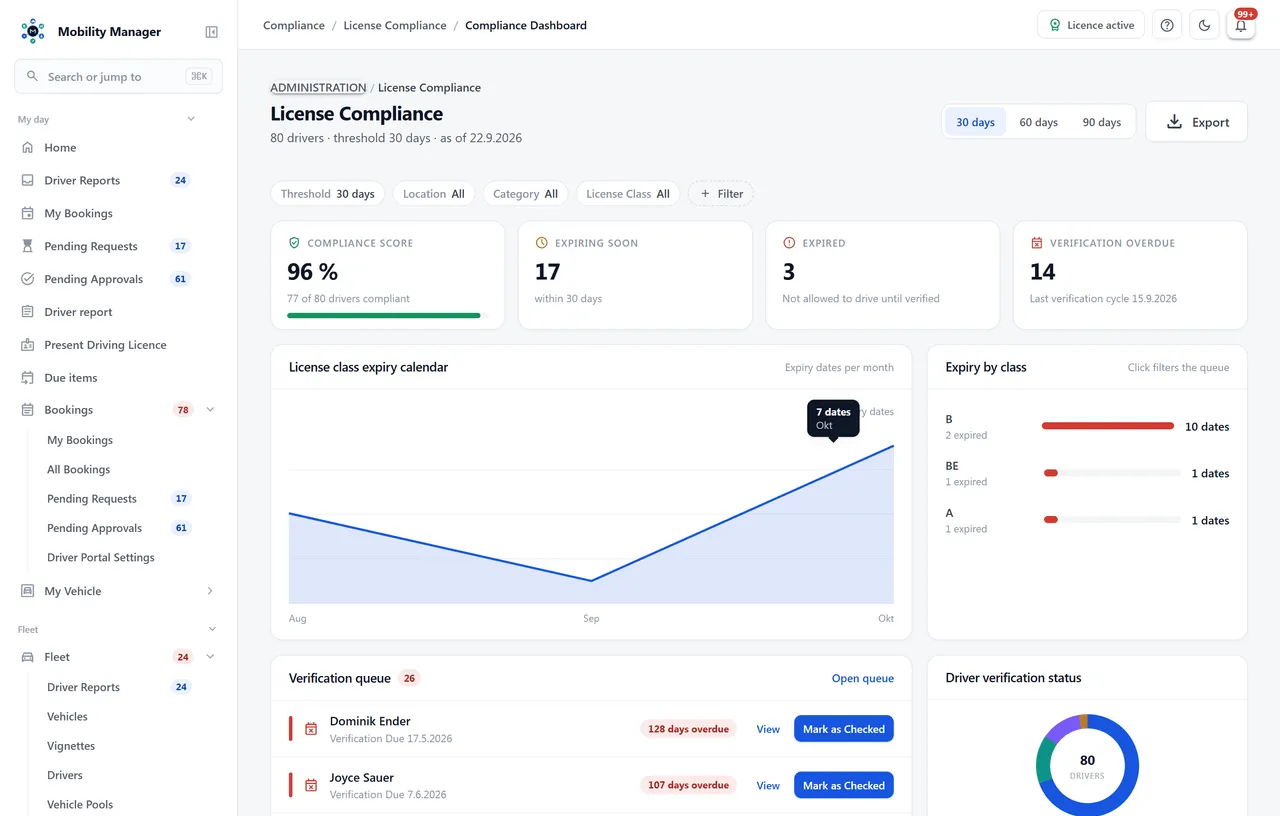
The operator duty that counts when it matters
Each driver carries licence classes, validity periods, restriction codes and — for professional drivers — the qualification record. The system reminds before expiry, runs the recurring check through a review queue, and can block bookings of vehicles whose required class is missing. The annual UVV driver safety instruction is a module of its own, built on the same driver file.
Driver instruction
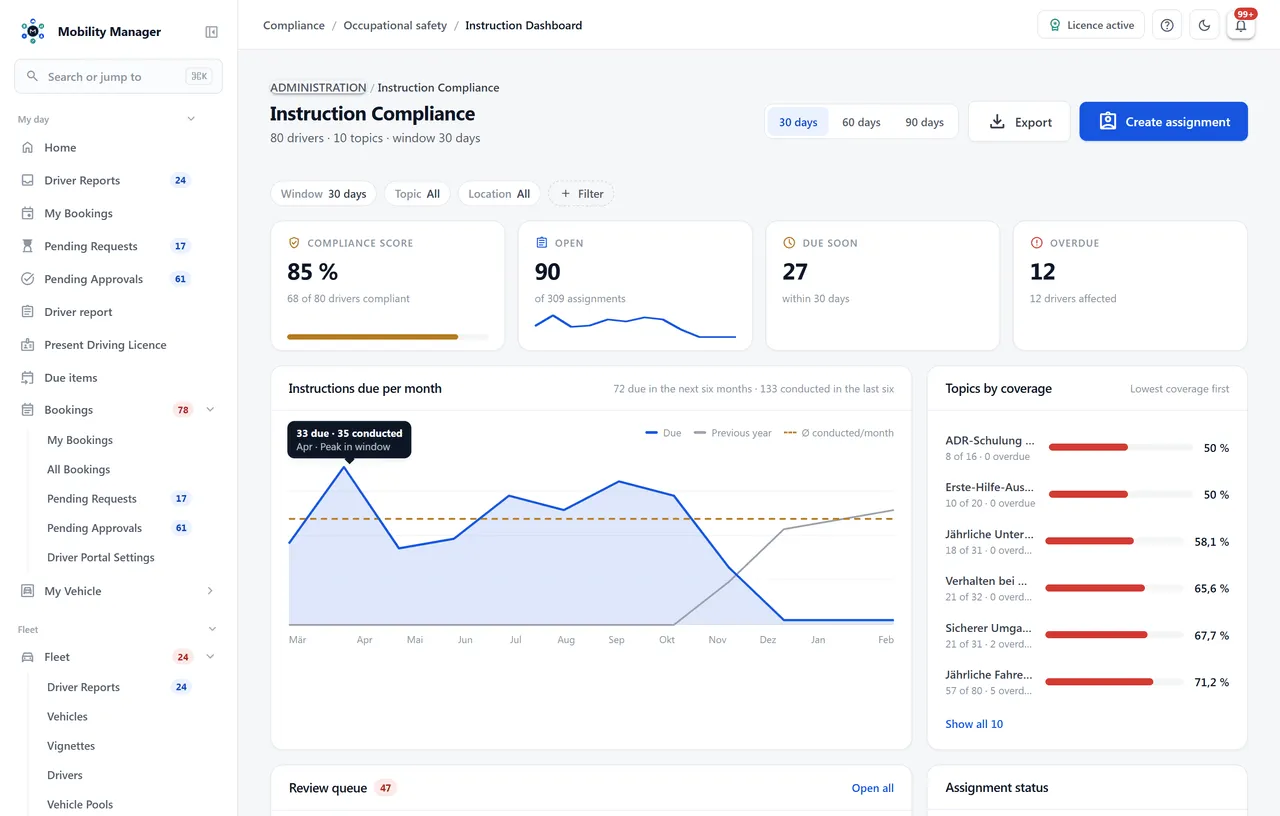
The annual instruction that runs itself
Instruction topics carry their legal basis and their repeat interval. Who needs one follows from the target group — department, location, cost centre or a credential such as the forklift licence — instead of a hand-kept list. The driver works through the sections, passes the comprehension check and acknowledges digitally; alternatively the signed attendance sheet is filed. If a credential is linked, its "next instruction" date on the driver file moves forward automatically on completion.
Legal register
The obligation knows its evidence
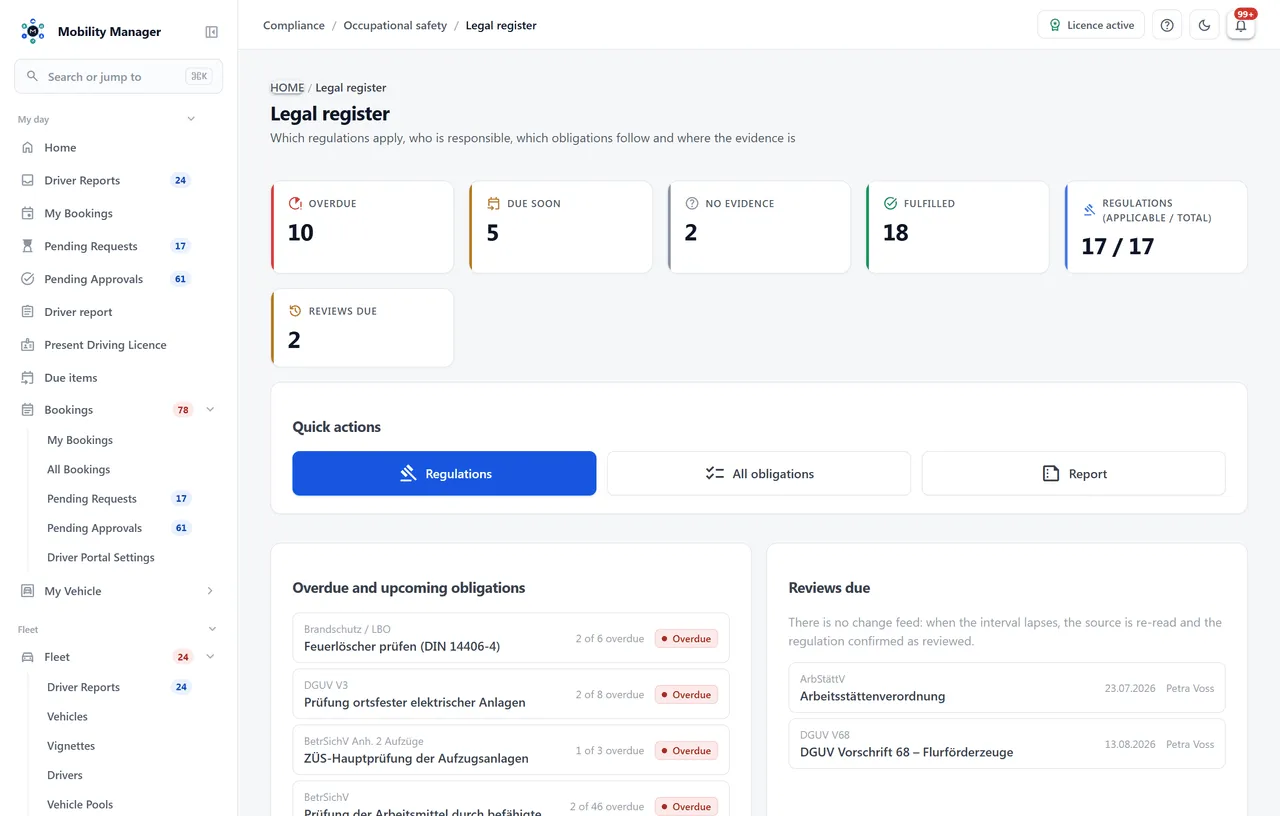
A regulation carries its kind, legal area, responsible person, source and a review interval. Obligations follow from it: an inspection, an instruction, a record, the appointment of an officer. Link an obligation to a maintenance template, an instruction topic or a credential from the driver file and its status is computed — "3 of 42 devices overdue" instead of a line somebody maintains by hand. What no module records gets its own due date and evidence with a document. This is explicitly not a change feed: each regulation is re-read against its source at the recorded interval and confirmed as reviewed.
Room register
Whoever comes in tomorrow already has a place today.
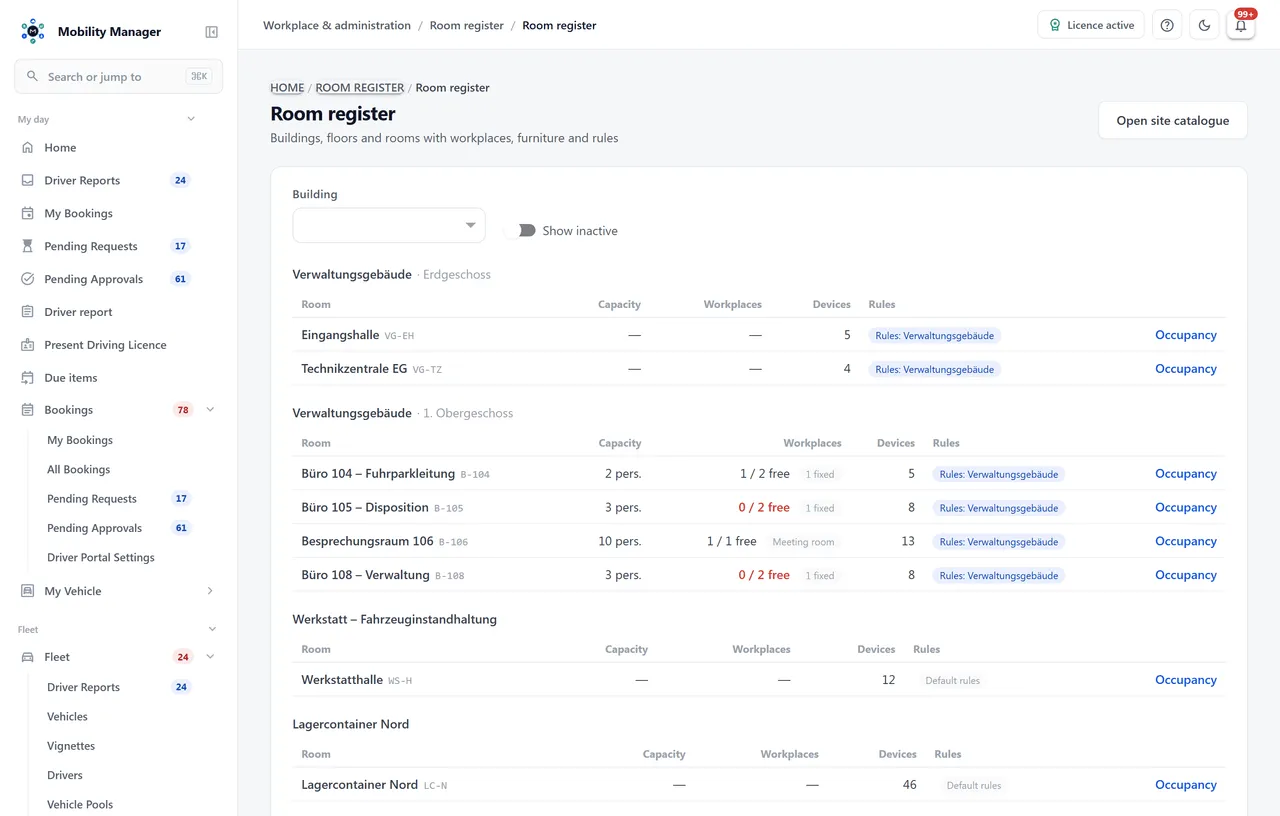
Hybrid working turned desks into a scarce resource: two days a week they are short, three days they stand empty. The room register models every room as part of the site tree — with area, capacity and the furniture in it — and makes desks and meeting rooms bookable. Fixed desks stay fixed, closures are dated, and anyone who stays home releases their desk with one tap.
Traffic fines
Hearing deadlines run. Even while you are on holiday.
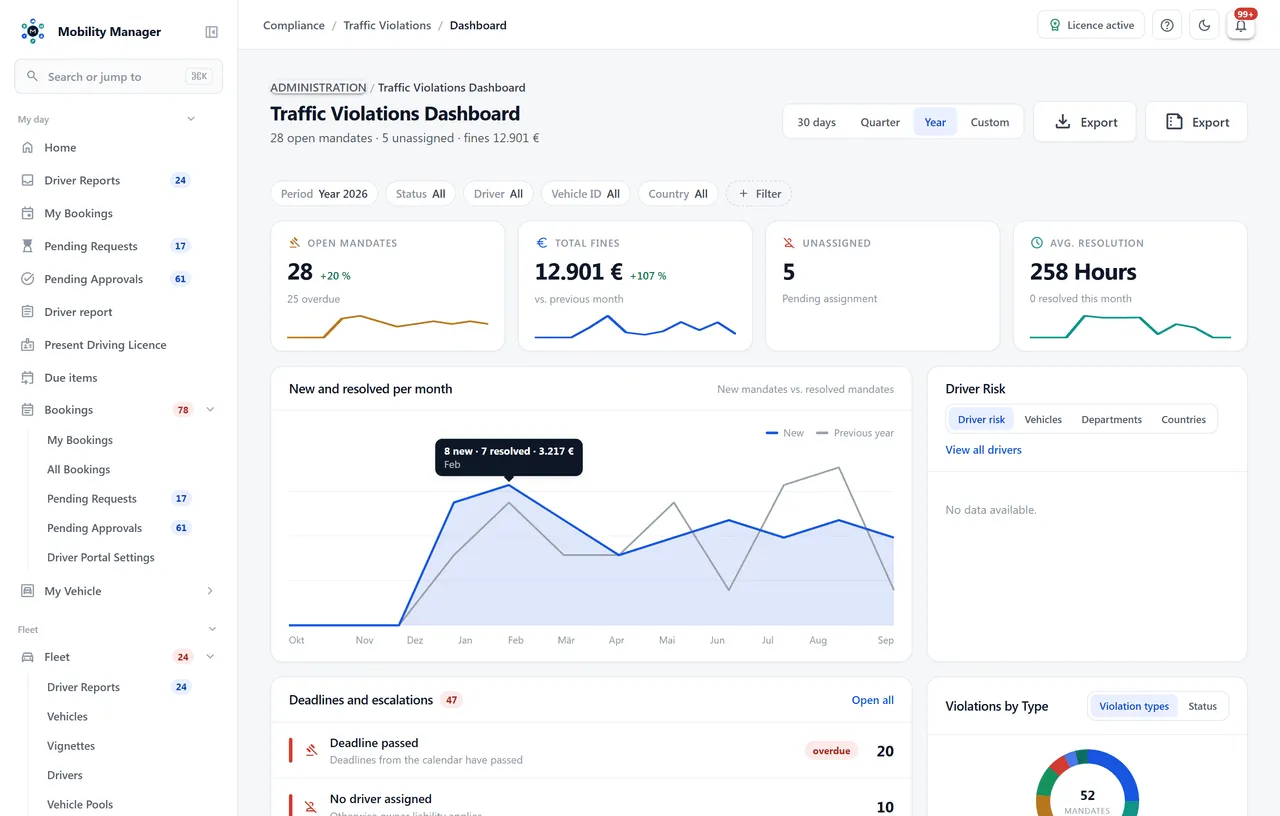
A penalty notice is not a letter, it is a case with a clock. The module computes deadlines, escalates automatically when they are about to slip, and documents the driver nomination so it can be evidenced later. Multiple notices can be imported instead of retyped.
Receipt management
Receipts that do not make the auditor nervous
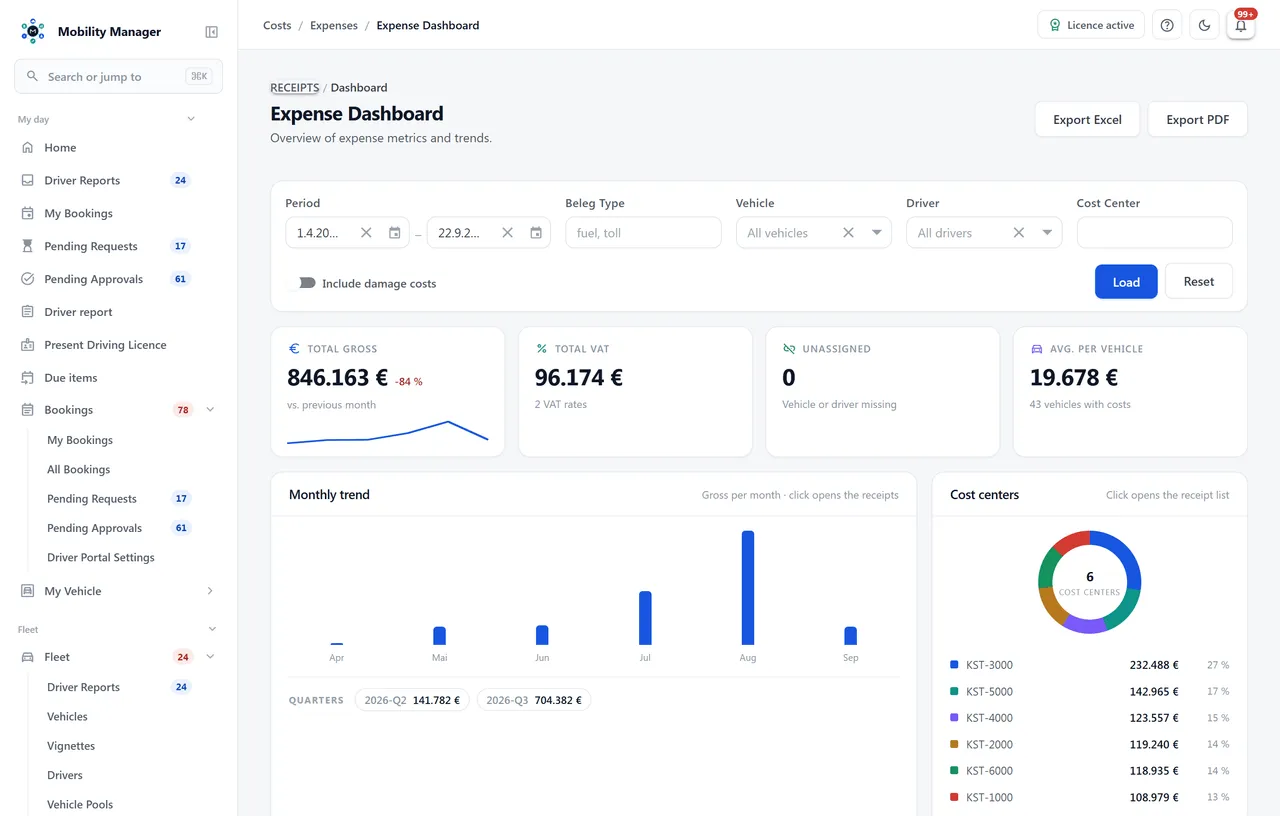
Rules have severities: an info note informs, a warning can be passed with a justified override, a blocker prevents the next step. Review stays strict where it must be and workable where it cannot be. Every override is logged with its justification.
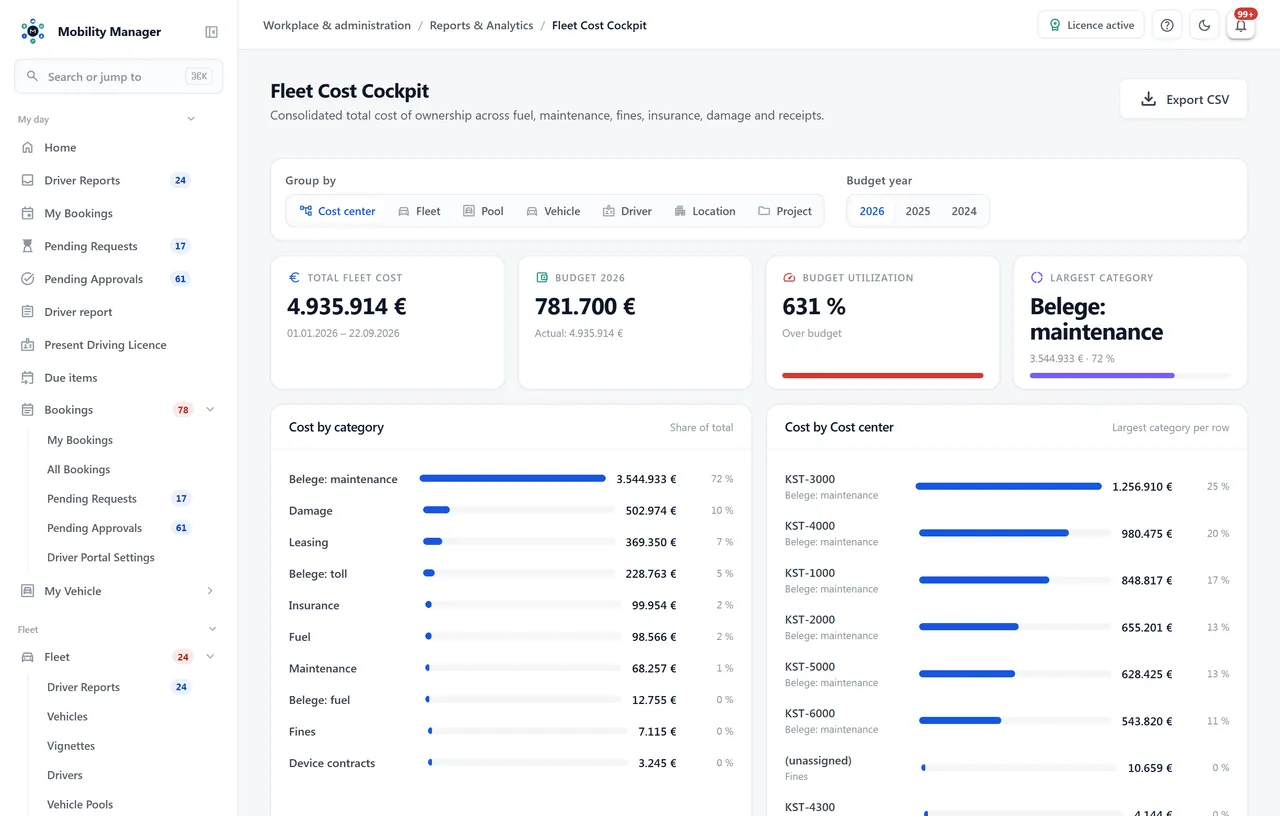
Fleet Cost Cockpit
What does this vehicle actually cost?
The cockpit does not recalculate, it consolidates: it pulls costs from the modules where they arise anyway. So the figures in the cockpit always agree with the underlying records — and every number stays traceable back to its originating case.
One installation, four areas
Core platform, compliance, workshop operations and finance in two packages: Essentials and Professional, with optional Mobile Connect and resources. One installation, with a consistent package scope.
Core platformThe foundation every other module builds on — vehicles, bookings, documents, roles and reporting.
Vehicle file
Every vehicle with technical data, registration, plate history, tyres, due dates and costs in one file.
Bookings & dispatch board
Self-service booking from assigned pools, approval workflow and a dispatch board for day-to-day planning.
Parking management
Manage parking spaces per site and let staff book them — including EV bays, visitor bays and permanently assigned spaces.
Room register
Buildings, floors and rooms on the site tree — staff book desks and meeting rooms themselves.
Driver submissions
Drivers report odometer, tyre change, damage and fuel receipts themselves — administration just reviews.
Driver file
Drivers as master records rather than shadows of a user account — with credentials, blocking and a 360-degree view.
Document management
Attach documents to vehicles, drivers, receipts, damages and fines, search them tenant-wide — on your own storage.
Roles, tenants & audit
Fine-grained permissions, custom roles, isolated tenants, site-based data visibility and an immutable audit log.
Reports & analytics
A report hub with 34 reports, one shared export layer and per-vehicle KPIs.
CRM & partners
Workshops, suppliers, insurers and authorities with contacts and a communication trail.
Email templates & delivery
Every system email in your wording and your design — with placeholders, live preview and an auditable send queue.
Automations
Rules of the form 'when X happens, do Y' — for deadlines, vehicle events and fixed schedules.
Telematics integration
Pull odometer readings and licence checks from your telematics portal — or from a file where there is none.
Compliance & operator liabilityProof obligations, deadlines and accountability documented instead of improvised.
Driving licence control
Licence data, recurring visual checks, a review queue and a booking block when the required class is missing.
Driver instruction
UVV driver safety instruction per DGUV regulation 1: topics with legal basis, e-learning with comprehension check, target groups, and credentials that keep themselves current.
Legal register
Which regulations apply, who is responsible, which obligations follow and where the evidence is — with a fulfilment status computed from maintenance planning, driver instruction and credentials.
Traffic fines
Record penalty notices, assign drivers, hold deadlines, run objections and allocate costs.
Digital logbook
Electronic logbook (Fahrtenbuch): recorded promptly, numbered without gaps and tamper-evident via a SHA-256 hash chain.
Car policy & vehicle ordering
Company car policy as a versioned rule set plus vehicle ordering with automatic policy checks and cost projection.
Workshop & operationsEverything that happens to a vehicle between registration and retirement.
Damage management
Damage cases from report to settlement — with liability classification, deadlines and costs.
Maintenance planning
Maintenance templates, plans by time or mileage, service history and reminders.
Workshop management
Work orders with line items, a status chain and costs — for your own workshop and for external ones.
Tyre management
Tyre sets, tread measurements per wheel position, two thresholds and the seasonal change campaign.
Fuel management
On-site tanks, refuellings, fuel cards, fuel prices and budgets with consumption analytics.
Equipment management
Small equipment, machines and batteries with inventory number, issue, return, defects and contracts.
Warehouse management
Spare parts and consumables with stock levels, movements, minimum stock and stocktaking.
Fuel card import
Read statement files, validate them by rules, release the flagged rows and only then post.
Finance & analyticsReceipts, insurance and the consolidated total cost of ownership of your fleet.
Receipt management
Capture receipts, validate them by rules, approve under four-eyes control and export with an audit trail.
Travel expenses
Settle business trips at a kilometre rate plus meal and overnight allowances — as a list payroll can take over.
Contract management
Leases, rentals and purchases with mileage terms, expiry monitoring, a return cockpit and vehicle tax.
Insurance management
Policies, premiums, certificates, risk profiles and loss ratio per vehicle and driver.
Fleet Cost Cockpit
Total cost of ownership across fuel, maintenance, leasing, fines, insurance, damages, receipts and devices.
Driver License Compliance – Führerscheinkontrolle
Legally required in Germany — automated and fully traceable.
German employers must verify driver licenses at least every 6 months under §21 StVG. MobilityManager will include a full compliance module: manual 4-eyes check logging, remote smartphone photo submission, automatic deadline tracking, GDPR-compliant consent flow, and a PDF evidence export for inspections.
Required by §21 Abs. 1 Nr. 2 StVG · Legal basis §26 BDSG · 6-month interval per BGH 1968
Ready for professional fleet management?
See MobilityManager in a 30-minute demo — self-hosted in your own data center, fully GDPR-compliant, Made in Germany.